
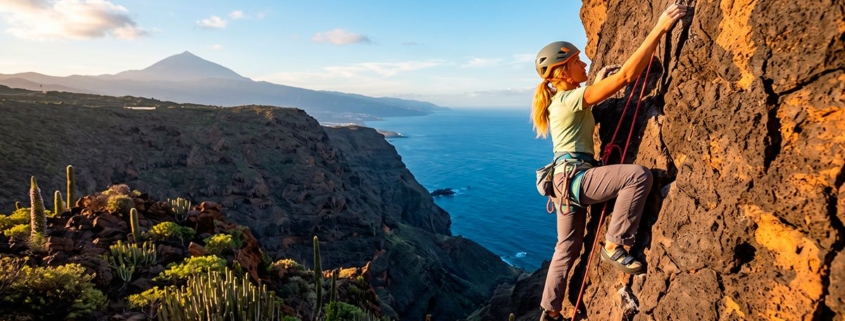
Tenerife is world-renowned for its beaches and the imposing Teide National Park, but for the climbing community, it’s a true paradise of volcanic rock. Thanks to its mild climate for much of the year, the variety of its climbing areas, and the incredible grip of the basalt, the island has established itself as one of the top destinations for sport and traditional climbing in Europe.
If you’re planning an adventure getaway, this guide details the best climbing areas on the island and how to sort out transportation logistics so you can focus solely on completing routes.
Main Climbing Areas in Tenerife
From dry, sunny ravines in the south to vertical spires in the north, Tenerife offers sectors for all levels and styles:
1. The South: Arico and its Ravines (The epicenter of climbing)
The municipality of Arico is the heart of sport climbing in the Canary Islands. It boasts over 1,000 equipped routes spread across several volcanic canyons, offering excellent holds and grades ranging from beginner (IV/5) to advanced (8 and 9).
- Arico Viejo and Arico Nuevo: The star sector. Its volcanic tuff walls offer crimps, cracks, and technical slabs. Furthermore, its orientation allows climbing in the shade or in the sun depending on the time of day.
- Tamadaya Canyon: A very extensive canyon, ideal if you are looking for tranquility and areas with short approaches.
- Barranco del Ortiz: Highly appreciated for the quality of its vertical slabs and the tranquility of the surroundings.
2. Boulder facing the Atlantic: El Porís de Abona
If bouldering is your thing, Porís de Abona is a must-do. You’ll climb on basalt formations sculpted by the wind and sea, literally just a few meters from the water. It’s a photogenic setting, perfect for winter afternoons.
3. The Southwest: Guaria (Guía de Isora)
Risco de Guaria (located in the Montaña de Tejina Natural Monument) is the most impressive rock climbing area in Tenerife. It features multi-pitch routes and a more adventurous character.
⚠️ Conservation note: As it is a Protected Natural Area for the preservation of birdlife, climbing in Guaria is subject to prior authorization managed through the Tenerife Island Council or the Tenerife On platform .
4. The North and Anaga: Classic Climbing and Wild Landscapes
For lovers of traditional adventure, the Anaga Rural Park is home to iconic rock formations such as Roque de las Ánimas and Roque de Enmedio . Here, the climbing is more demanding, often classic or semi-equipped, surrounded by a lush laurel forest and spectacular views of the Atlantic.
Technical Data Sheet for Climbing in Tenerife
| Feature | Detail |
| Rock type | Basalt and volcanic tuff (high adhesion) |
| Modalities | Sport climbing, traditional/multi-pitch climbing, bouldering |
| Best time | All year round (Autumn-Spring is peak season) |
| Recommended material | 70-80m rope, 14-18 quickdraws, helmet and climbing shoes |
No experience? Baptisms and Climbing Walls
Tenerife isn’t just for experts. If you’re traveling to the island and want to try climbing for the first time:
- Rock climbing baptisms: Several active tourism companies in the south of the island offer half-day trips in Arico, providing all the equipment (harness, climbing shoes, helmet) and certified guides.
- Indoor climbing walls: If you happen to have one of the (rare) rainy days, or simply want to train, the island has excellent climbing walls and bouldering gyms, especially in the La Laguna and Santa Cruz area, and specialized centers in the south.
Tips for a Safe and Sustainable Day
- Respect local regulations: Check temporary bird nesting restrictions on the Tenerife Island Council website or on Tenerife On before visiting areas such as Guaria.
- Wear a helmet: Even if the routes are well-maintained, volcanic rock can dislodge small stones, especially in less frequented areas.
- Be careful with the sun and stay hydrated: In the southern canyons, solar radiation is intense even in winter. Bring plenty of water and sunscreen.
- Apply the “Zero Footprint” principles: Collect all your trash, use magnesium sparingly, and respect the rural environment and private properties near the approaches.
Logistics: How to Travel with Your Equipment (Without Complications)
Traveling with all your climbing gear can be a hassle. Ropes, harnesses, 40-liter backpacks, and especially bulky bouldering crash pads are incompatible with regular public transport and a real headache in small rental cars.
To ensure a comfortable transfer to your accommodation or directly to the canyon, the smartest option is to book a taxi with us to travel comfortably with your team.
More information
Canary Islands Mountain Federation: fecamon.es/