
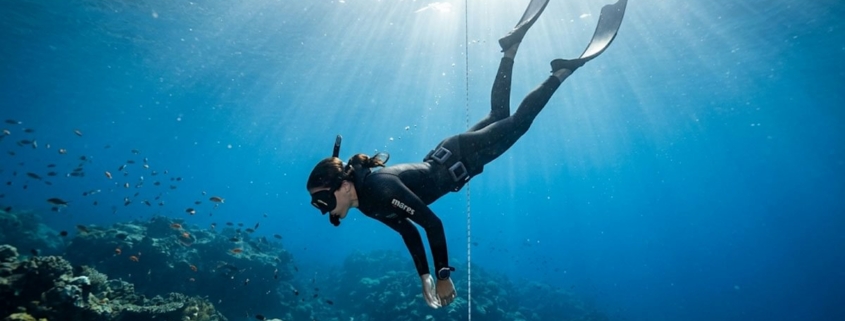
Submerging in the ocean while holding your breath is much more than an extreme sport; it’s a discipline of self-discovery, relaxation, and absolute connection with the marine environment. By gliding beneath the surface without the noise of bubbles from scuba tanks, you become one with the ocean, allowing marine life to approach you naturally.
Tenerife has established itself as a true world paradise for freediving . With visibility that often exceeds 30 meters, water temperatures ranging from 19ºC in winter to 24ºC in summer, and the possibility of reaching great depths just a few meters from the shore, the island is the preferred destination for both world champions looking to train and travelers wanting their first freediving experience.
And if you’re traveling with your long fins and heavy equipment, remember that at Official Taxi Tenerife we have spacious vehicles to take you comfortably to the best diving spots on the island.
Why Tenerife is the mecca of freediving
Beyond the climate, the island’s volcanic origin is largely responsible for its success. The island’s continental shelf drops off sharply very close to the coast, meaning that renting boats isn’t necessary to find deep water. Furthermore, this same geology has created fascinating underwater landscapes: basalt arches, dark caves, and vertical walls teeming with life.
As you dive in silence, it is common to come across green turtles, chuchos (local rays), schools of salema fish and, with a bit of luck, majestic angel sharks resting on the sandy bottoms.
The best spots for freediving in Tenerife
The island’s underwater volcanic topography gives it impressive vertical drops very close to the coast. These are the most outstanding locations:
- Radazul: The undisputed freediving capital of Europe. Its bay is sheltered from currents and wind for most of the year. It features permanently installed descent lines, allowing you to reach depths of over 40 meters by swimming for just a couple of minutes from the dock steps.
- Tabaiba and the wreck of “El Peñón”: Just a few kilometers from Radazul, this intentionally sunk tugboat rests at a depth of about 30 meters. It’s a spectacular spot for advanced freedivers looking to explore submerged structures in a controlled environment.
- The West Coast (Guía de Isora and Santiago del Teide): Areas like Playa San Juan and Alcalá offer spectacular submerged lava formations. The water here is usually crystal clear, ideal for recreational freediving and underwater photography.
- The Palm-Mar: Its coastal cliffs, known as the Palm-Mar Wall, offer impressive vertical drops and a very high probability of swimming alongside turtles and rays in their natural habitat.
The necessary equipment: Less is more
Unlike scuba diving, freediving requires minimalist and specific equipment designed for hydrodynamics:
- Low volume mask: Essential to facilitate air equalization as pressure increases with depth.
- Long fins: Made of plastic, fiberglass or carbon, they provide the necessary thrust to ascend from the bottom with minimal effort.
- Microporous neoprene wetsuit: It is usually two-piece, very elastic and without zippers to maximize mobility and maintain body temperature by preventing water circulation inside.
- Elastic weight belt: It fits the body and does not slip down towards the chest when the suit is compressed by pressure during the descent.
Leading schools and training centers
Freediving is 90% mental and 10% physical. Learning the correct techniques for diaphragmatic breathing, relaxation, and equalization (such as the Frenzel maneuver ) is vital. Tenerife boasts elite professionals and schools certified by leading agencies (AIDA, SSI, Molchanovs).
- Apnea Canarias (Radazul): An internationally renowned center founded by champions of the sport. They have waterside facilities, ideal for courses of all levels and deep-diving training.
- Apnea Academy West Europe (La Caleta / Costa Adeje): Specialists in the mind-body connection, they organize dives, complete courses and guided excursions to explore the treasures of the west coast.
- Atlantis Freediving (Tabaiba): They offer a very personal service and progressively structured courses, with the great advantage of having the famous Tabaiba wreck just a few meters away for open water practice.
Recommendations for your lung-filled trip
- Never dive alone: The golden rule of freediving is to always go with a buddy. The buddy system is vital for safety in the water.
- Take advantage of introductory freediving sessions: If you have no experience, a multi-week course isn’t necessary. You can book a one-day introductory freediving session to safely experience the relaxation and beauty of the Atlantic seabed.
- Transport your gear stress-free: Freediving fins are extremely long and delicate, and weight belts are heavy. Avoid crowded public transport or small rental cars. Book with Official Taxi Tenerife from the South or North Airport, and we guarantee a spacious vehicle and a direct route so you can focus solely on your breathing.
More information
Canary Islands Federation of Underwater Activities: fedecas.es/